Centennial Centre: Centennial Concert Hall, Manitoba Museum, Planetarium
| Address: | 555 Main Street |
|---|---|
| Constructed: | 1968–1970 |
| Other Work: | 1990 addition |
| Architects: |
|
Photographs
More Information
The Manitoba Centennial Centre, comprising the Centennial Concert Hall and the Manitoba Museum and Planetarium, was constructed to commemorate Canada’s (1967) and Manitoba’s (1970) centennials. The Centre was designed by a consortium of local firms called Associated Architects for the Manitoba Cultural Centre. Participating firms were Green Blankstein Russell and Associates, Moody Moore Whenham and Partners, and Smith Carter Searle Associates. The Concert Hall officially opened in March 1968, followed by the Planetarium in May of that year, and the Museum in July 1970.
The concept of a new centre for the arts emerged in the late 1950s. The original impetus was twofold: to replace the outdated Winnipeg Auditorium and to encourage renewal of the Main Street area. The Manitoba government, under Premier Duff Roblin, sought to renew south Point Douglas and nearby Main Street. The provincial government also persuaded the City of Winnipeg to locate the new City Hall in this area to reinforce the urban renewal initiative. The Centre was seen as the impetus for an arts and cultural area extending east along Market Avenue to the Red River, providing a stimulus for renewal of the area east of Main Street. The Royal Manitoba Theatre Centre was eventually constructed nearby, but the Winnipeg Art Gallery and the Royal Winnipeg Ballet were built elsewhere in the city’s downtown.
The Province established the Manitoba Centennial Corporation to oversee the project, which initially included an art gallery. The complex was completed at a cost of $20 million with $4.5 million coming from private donors.
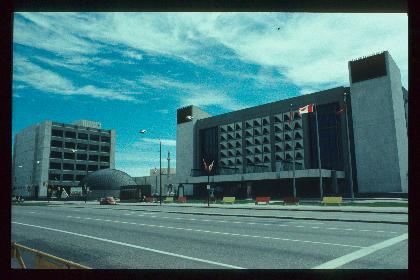
The buildings use a restrained palette of materials and colours including light-grey Tyndall limestone, expressed aggregate precast concrete panels and bronze-coloured doors and window framing. The planetarium is clad in sheet copper above a precast concrete base. A small forecourt along Main Street provides a vehicle drop-off area and a setting for the relocated Volunteers Monument. Steinkopf Gardens, an urban oasis between the Concert Hall and Museum, extends east to Martha Street.
Design Characteristics
| Materials: | copper, Tyndall stone |
|---|
- A collection of three separate buildings: concert hall, planetarium, and museum
- Steinkops Gardens accompanies buildings
- Concert hall has dramatic facade, two large Tyndall limestone towers to north and south elevations
- Eyelid-like hooded window covers along concert hall’s Main Street facade
- Planetarium accessed through museum basement; copper domed roof
- Museum uses similar materials such as Tyndall limestone; large six-storey tower on corner of Main Street and Rupert Avenue
- Gardens located between museum and concert hall
Links & Related Places
- Centennial Concert Hall, 555 Main Street
- Steinkopf Gardens, 555 Main Street
- The Manitoba Museum, 190 Rupert Avenue
- Winnipeg Civic Centre (City Hall and Administration Building), 510 Main Street
- GBR (Green Blankstein Russell)
- Moody Moore Architects
- Smith Carter