Architects
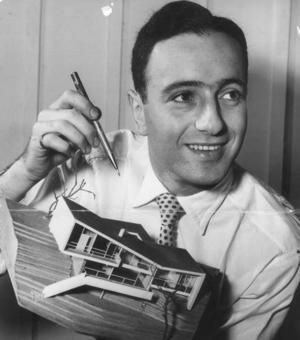
Harry Seidler AC OBE
Born: –Died:
Education/accreditation: Bachelor of Architecture, First Class Honours (University of Manitoba), 1944
Master of Architecture (Harvard School of Design), 1946
Biography
Often described as the ‘father of Australian modernism’, Harry Seidler was a champion of dramatic yet graceful architecture and the designer behind many landmark Australian buildings. His career spanned decades and continents, becoming one of the most influential modernist architects of the twentieth century.
Mr Seidler was born in Vienna, Austria, on 25 June 1923, the son of a Jewish clothing manufacturer. Following the Nazi annexation of Austria in 1938, he fled to England to join his brother in Cambridge, where he began taking architectural courses at the Cambridgeshire Technical School.
Despite wartime policies toward foreign-born refugees, and despite being classified as a ‘no-risk’ refugee fleeing Nazi persecution, he was interned by British authorities and sent to camps at Huyton (near Liverpool), the Isle of Man and later to Quebec, Canada. In October 1941, he was released from internment after being accepted to study at the University of Manitoba’s School of Architecture in Winnipeg, Canada.
Mr Seidler quickly distinguished himself as an exceptional student, pursuing formal architectural education in Winnipeg at a time when the school’s architecture programme was emerging as an important centre for modernist thinking in Canada. The University of Manitoba was one of the first Canadian architecture schools to accept students traditionally excluded from architectural educations, including women, Jews, and immigrant communities. His period of study aligned with formative opportunities and connections, learning from the school’s pioneering proponents of Canadian modernism. He graduated with first-class honours in 1944 and his accomplishments contributed to the growing recognition of the University of Manitoba as one of Canada’s earliest and most internationally connected schools of architecture.
After the University of Manitoba, Mr Seidler furthered his studies at the Harvard Graduate School of Design under leading modernist figures such as Walter Gropius and Marcel Breuer. These experiences strongly shaped his commitment to the principles of modern architecture and to the public advocacy of modern design. After his studies in the United States, he briefly worked in Rio de Janeiro with the renowned Brazilian architect Oscar Niemeyer.
In June 1948, Mr Seidler took up an offer made in a letter from his mother inviting him to join his parents in Australia—just days before his 25th birthday. They had asked the young architect to design a new home for them in Sydney. Although he did not intend to remain in Australia, this commission marked the beginning of his long connection with the country.
The house Mr Seidler designed for his parents became known as the Rose Seidler House on Clissold Road in Wahroonga, New South Wales, built between 1948 and 1950. Set amidst rugged bushland in a suburb on Sydney’s Upper North Shore, the project is widely considered the first fully realised modern residence in Australia to express the philosophy and visual language of the Bauhaus. The house received the prestigious Sir John Sulman Medal in 1951. With the recognition and publicity generated by this project, the young architect was soon approached to design additional houses in Sydney. Mr Seidler gained many new clients and was drawn to Sydney’s climate and harbour landscape, ultimately deciding to remain in Australia.
In 1958 Harry Seidler married architect Penelope Seidler (née Evatt). She later joined his practice and, from 1964 onward, worked as both an architect and financial manager at their firm, Seidler and Associates. Together they co-designed the Harry and Penelope Seidler House in Killara, which received the Wilkinson Award in 1967. Married for 48 years, the couple had two children.
Mr Seidler reshaped Australia’s post-war architectural landscape, practising as one of the nation’s leading architects for more than fifty years. Through extensive lectures and international travel, he became an outspoken—and at times controversial—advocate for modern architecture. Notably, his advocacy in 1966 supported public protests calling for Jørn Utzon to remain principal architect of the Sydney Opera House.
Seidler received numerous honours during his lifetime. He was a founding member of the Australian Architecture Association; in 1984 he became the first Australian elected to the Académie d’architecture; and in 1987 he was appointed a Companion of the Order of Australia. Over the course of his career he received five Sir John Sulman Medals from the Royal Australian Institute of Architects, the Institute’s Gold Medal in 1976, and the Royal Gold Medal by the Royal Institute of British Architects in 1996.
Seidler died on 9 March 2006 at the age of 82.
Projects
Rose Seidler House, Sydney, 1948–1950
Australia Square, Sydney, 1961–1967
MLC Centre, Sydney, 1972–1978
Theatre Royal, Sydney, 1976
Australian Embassy, Paris, 1973–1977
Grosvenor Place, Sydney, 1982–1988
Significant Dates
- October 1941 –
Begins studies at the University of Manitoba School of Architecture in Winnipeg, Canada
- May 1940 –
Interned during WW2
- 1944 –
Graduates with First-Class Honours
Sources
Photographs